iPhone 18 Could Bring Powerful AI Accessibility Features With VoiceOver, Speech Recognition and More
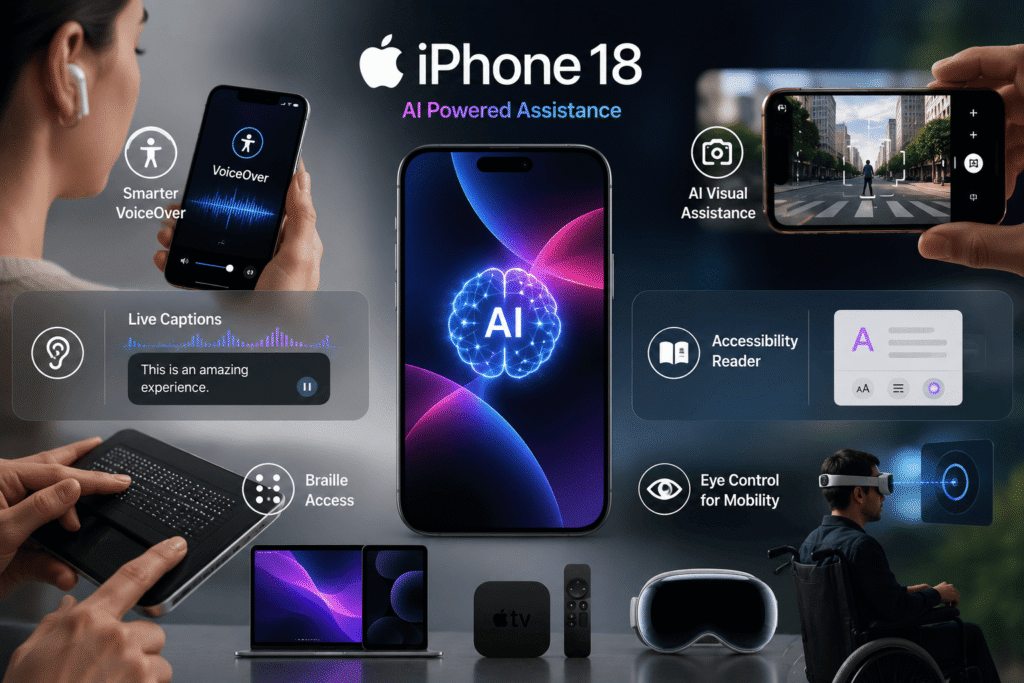
Ahead of WWDC 2026, Apple has unveiled a major new set of accessibility features powered by Apple Intelligence — the company’s on-device AI ecosystem.
The new AI-driven accessibility tools are expected to roll out across:
- iPhone
- iPad
- Mac
- Apple TV
- Apple Vision Pro
Unlike many AI announcements focused mainly on entertainment or productivity, Apple is positioning these upgrades around accessibility, inclusion, and real-world assistance.
The company says the new tools are designed to support users with:
- Vision impairments
- Hearing disabilities
- Mobility limitations
- Dyslexia
- Cognitive accessibility needs
Smarter VoiceOver With AI-Powered Visual Understanding
One of the biggest upgrades is arriving for VoiceOver — Apple’s screen-reading system used by visually impaired users.
Powered by Apple Intelligence, VoiceOver will now offer:
- More detailed image descriptions
- Better document understanding
- Context-aware screen explanations
- Improved object and label recognition
Users will also be able to ask questions about what the camera sees using natural conversational language.
Apple says the AI system can help describe surroundings, identify objects, and explain visual information in much greater detail than before.
AI-Powered Magnifier and Voice Controls
The Magnifier app is also receiving major upgrades.
Users will reportedly be able to issue spoken commands like:
- “Zoom in”
- “Turn on flashlight”
- “Describe surroundings”
The system combines AI-powered visual interpretation with voice navigation to improve accessibility for users with low vision.
Automatic AI Captions for Videos
Apple is also improving accessibility for hearing-impaired users.
Devices powered by Apple Intelligence will now be able to:
- Automatically generate subtitles
- Create captions for previously uncaptioned videos
- Use on-device speech recognition for real-time processing
This feature is expected to work across supported Apple devices without requiring cloud processing.
Accessibility Reader Gets Smarter
Apple is upgrading its Accessibility Reader with several AI-powered capabilities.
The feature can now:
- Simplify difficult text
- Summarise long articles
- Translate content
- Improve readability for dyslexic users
- Customise fonts, spacing, and colours
The system will also work through the camera, allowing users to:
- Read menus
- Scan books
- Understand signs
- Process printed documents more easily
Apple Expands Braille Support
Apple is also placing major focus on braille accessibility.
The new Braille Access feature will effectively turn:
- iPhones
- iPads
- Macs
- Vision Pro devices
into full braille note-taking systems.
Users will be able to:
- Take notes in braille
- Open BRF files
- Use Nemeth Braille calculations
- Launch apps using braille input
- Use live captions with braille displays
Accessibility experts believe this could reduce dependence on expensive standalone braille hardware.
Vision Pro Gets Eye-Controlled Wheelchair Support
One of the most futuristic announcements involves Apple Vision Pro.
Apple revealed that Vision Pro’s eye-tracking system will support compatible powered wheelchairs, allowing users to control mobility systems using eye movement alone.
The feature is expected to support:
- LUCI systems
- Tolt mobility systems
in the United States.
Apple also announced:
- Improved zoom tools
- Motion sickness reduction features
- External camera accessibility APIs
- Better environmental magnification
Accessibility Is Becoming the Next Big AI Battleground
Apple’s announcements reflect a much larger industry trend.
For years, accessibility tools were treated as secondary operating system features. But advances in:
- Artificial intelligence
- Machine learning
- Computer vision
- Speech processing
are now turning accessibility into one of the most practical and important real-world uses of AI.
Companies increasingly view accessibility as:
- A core design philosophy
- A legal requirement
- A competitive advantage
- A social inclusion initiative
Apple’s AI Strategy Looks Different From Rivals
Industry analysts believe Apple is trying to position Apple Intelligence differently from competitors focused mainly on AI chatbots and content generation.
Instead, Apple appears to be emphasizing:
- Privacy-focused AI
- On-device intelligence
- Deep operating system integration
- Real-world usability
The accessibility features announced ahead of WWDC 2026 may also offer an early preview of much broader AI upgrades coming to future iPhones, including the rumoured iPhone 18 lineup.
Apple’s latest push suggests the company wants AI to become something users rely on daily — not just for entertainment, but to genuinely improve accessibility and quality of life for millions of people worldwide.