China Develops Hair-Thin Carbon Fibre Stronger Than Steel
has unveiled a major breakthrough in advanced materials technology with the development of a new ultra-high-strength carbon fibre known as T1200-grade fibre, or SYT80.
Researchers claim the material is nearly 10 times stronger than conventional steel while being thinner than a strand of human hair and significantly lighter in weight.
The breakthrough has now reportedly entered industrial-scale production, marking a major step forward for the global carbon fibre industry.
Ultra-Thin Fibre Powerful Enough To Pull a Bus
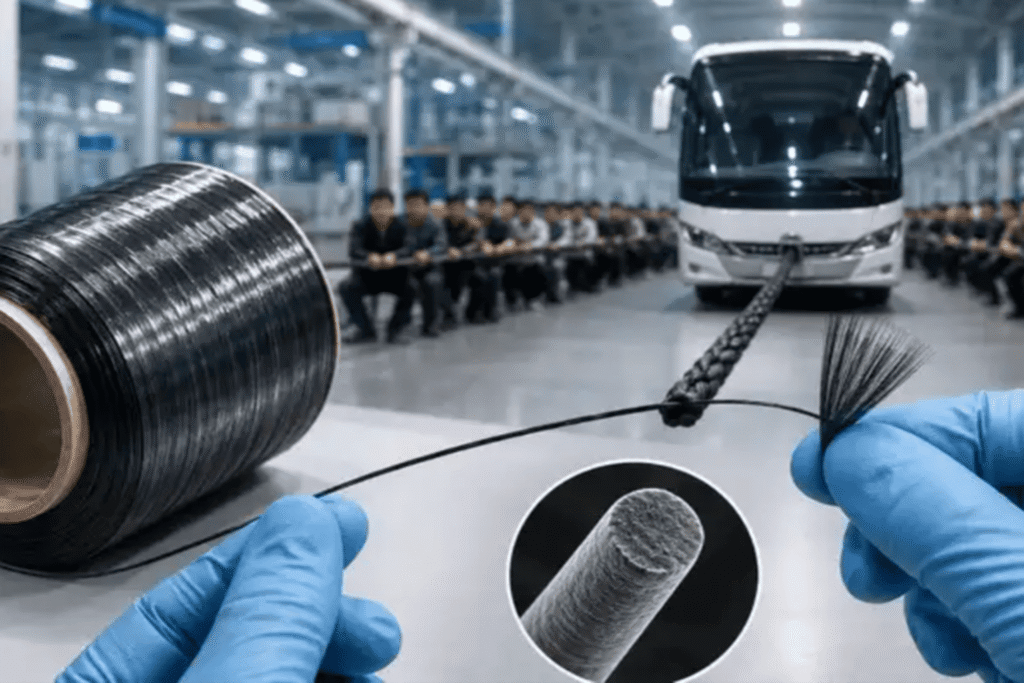
To showcase the material’s strength, Chinese researchers combined around 120,000 microscopic carbon filaments into a rope measuring less than 2 millimetres thick.
Despite its tiny size, the rope reportedly managed to pull a full-sized coach carrying 54 adults.
According to reports, the fibre achieves:
- Tensile strength exceeding 8 gigapascals (GPa)
- Around 10 times the strength of ordinary structural steel
- Roughly one-quarter the weight of steel
This combination of ultra-lightweight structure and extreme durability makes it one of the strongest commercially produced fibres in the world.
Thinner Than Human Hair
One of the most impressive aspects of the T1200-grade fibre is its microscopic size.
Scientists say the fibre is:
- Less than one-tenth the thickness of human hair
- Extremely lightweight
- Highly resistant to stress and deformation
Achieving both ultra-thin dimensions and ultra-high strength at the same time is considered one of the most difficult engineering challenges in materials science.
How China Created the T1200 Carbon Fibre
The manufacturing process reportedly involves several highly controlled heat-treatment stages.
The process includes:
- Oxidation at temperatures between 200°C and 300°C
- Carbonisation at temperatures approaching 2,000°C
- Formation of an ultra-stable molecular structure
These extreme processing conditions help create the fibre’s remarkable strength-to-weight ratio.
China Claims Industrial-Scale Production
Unlike many experimental materials that remain confined to laboratories, China says the T1200-grade fibre has already entered stable mass production.
According to reports, state-owned China National Building Material Group has achieved:
- Annual production capacity exceeding hundreds of tons
- Large-scale industrial manufacturing capability
- Stable commercial-grade production
Chinese officials claim this makes China one of the first countries capable of mass-producing T1200-grade carbon fibre at industrial scale.
Industries That Could Be Transformed
Experts believe the new material could dramatically impact industries where lightweight strength is critical.
Potential applications include:
- Aerospace and defence systems
- Electric vehicles (EVs)
- Hydrogen storage tanks
- High-speed rail systems
- Wind turbine blades
- Robotics
- Drones and air taxis
- Advanced construction and infrastructure
The ultra-lightweight nature of the fibre could help reduce fuel consumption, improve battery efficiency, and increase overall performance across multiple industries.
Global Carbon Fibre Competition Intensifies
For years, companies from Japan and the United States dominated the high-performance carbon fibre industry.
Japanese firm Toray Industries has long been considered a leader with its T1100-grade carbon fibres.
However, China’s entry into industrial-scale T1200 production could significantly reshape global supply chains and increase competition in advanced composite materials.
Demand for Advanced Materials Is Rising Fast
Analysts believe global demand for ultra-high-strength carbon composites will grow rapidly over the next decade due to expansion in:
- Electric vehicles
- Renewable energy systems
- Aerospace manufacturing
- Hydrogen mobility infrastructure
- Defence technology
As industries push for lighter, stronger, and more energy-efficient materials, breakthroughs like China’s T1200-grade carbon fibre could become increasingly important.
Quick Summary
China has developed a new T1200-grade carbon fibre that is reportedly 10 times stronger than steel while remaining thinner than human hair. Researchers demonstrated its strength by pulling a coach carrying 54 adults using a tiny fibre rope. China says the material has now entered industrial-scale production and could transform industries including aerospace, EVs, robotics, and renewable energy.