Apple Announces New AI-Powered Accessibility Features for iPhone, Mac and Vision Pro
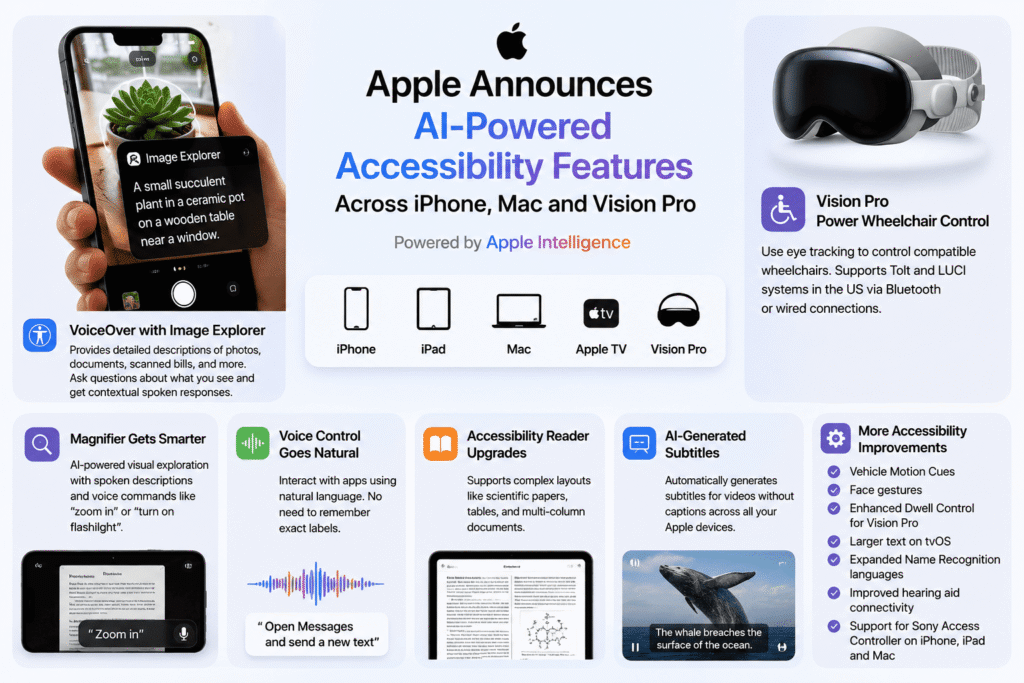
Ahead of WWDC 2026, Apple has unveiled a major set of AI-powered accessibility features designed for iPhone, iPad, Mac, Apple TV, and Apple Vision Pro.
The company says the new tools are powered by Apple Intelligence and aim to improve accessibility using voice, vision, motion, and language-based controls across its ecosystem.
VoiceOver Gets AI-Powered Image Descriptions
Apple is upgrading the VoiceOver feature with a new “Image Explorer” capability. The AI-powered tool can now provide detailed spoken descriptions of:
- Photos
- Scanned bills
- Documents
- Visual content
Supported iPhone users can also activate the feature using the Action Button to ask questions about objects or scenes visible through the camera viewfinder.
Magnifier and Voice Control Receive Smarter Features
The Magnifier app is gaining AI-based visual exploration features with spoken descriptions and voice-controlled actions such as:
- “Zoom in”
- “Turn on flashlight”
Apple is also improving Voice Control with more natural conversational understanding. Users will reportedly be able to interact with apps by describing interface elements naturally instead of memorising exact command labels.
Accessibility Reader Now Supports Complex Documents
The updated Accessibility Reader can now better handle:
- Scientific papers
- Tables
- Multi-column layouts
- Complex documents
This improvement is aimed at making advanced reading material more accessible for visually impaired users.
AI-Generated Subtitles for Videos
Apple also announced automatic AI-generated subtitles for videos that do not already include captions.
The feature can transcribe spoken dialogue across:
- iPhone
- iPad
- Mac
- Apple TV
- Vision Pro
The subtitles are generated using on-device speech recognition, and users can customise them through playback settings.
Vision Pro Gets Eye-Tracking Wheelchair Controls
For Apple Vision Pro users, Apple introduced a new accessibility feature that allows compatible powered wheelchairs to be controlled using eye-tracking technology.
Initially, the feature will support:
- Tolt wheelchair systems
- LUCI wheelchair systems
The functionality will be available in the US through Bluetooth and wired accessory connections.
Other Accessibility Improvements
Apple also revealed several smaller upgrades, including:
- Vehicle Motion Cues
- Face gesture controls
- Improved Dwell Control eye-selection
- Larger text support on tvOS
- Expanded Name Recognition language support
- Better hearing aid connectivity
- Support for the Sony Access Controller on iPhone, iPad, and Mac
The company is expected to share more details about these AI-powered accessibility tools during WWDC 2026.